第 4 节 / 共 4 节
语音大模型:语音识别与合成
语音大模型课件
- 📕 CLIP正式版.pdf 3.4MB
- 📎 星火大模型(博学谷).pdf原文 12.1MB 过大未收录 · 保留文字提取版
📄 CLIP正式版.pdf · 文字提取版
以下为 PDF 文字提取版(排版有简化,原文见附件)。
第 1 页
Learning Transferable Visual Models From Natural Language Supervision Alec Radford * 1 Jong Wook Kim* 1 Chris Hallacy 1 Aditya Ramesh 1 Gabriel Goh 1 Sandhini Agarwal 1 Girish Sastry 1 Amanda Askell 1 Pamela Mishkin 1 Jack Clark 1 Gretchen Krueger 1 Ilya Sutskever 1 Abstract SOTA computer vision systems are trained to pre- dict a fixed set of predetermined object categories. This restricted form of supervision limits their generality and usability since additional labeled data is needed to specify any other visual con- cept. Learning directly from raw text about im- ages is a promising alternative which leverages a much broader source of supervision. We demon- strate that the simple pre-training task of predict- ing which caption goes with which image is an efficient and scalable way to learn SOTA image representations from scratch on a dataset of 400 million (image, text) pairs collected from the inter- net. After pre-training, natural language is used to reference learned visual concepts (or describe new ones) enabling zero-shot transfer of the model to downstream tasks. We study performance on over 30 different computer vision datasets, spanning tasks such as OCR, action recognition in videos, geo-localization, and many types of fine-grained object classification. The model transfers non- trivially to most tasks and is often competitive with a fully supervised baseline without the need for any dataset specific training. For instance, we match the accuracy of the original ResNet50 on ImageNet zero-shot without needing to use any of the 1.28 million training examples it was trained on. We release our code and pre-trained model weights at https://github.com/OpenAI/CLIP. 1. Introduction and Motivating Work Pre-training methods which learn directly from raw text have revolutionized NLP over the last few years (Dai & Le, 2015; Peters et al., 2018; Howard & Ruder, 2018; Radford et al., 2018; Devlin et al., 2018; Raffel et al., 2019). The development of “text-to-text” as a standardized input-output *Equal contribution 1OpenAI, San Francisco, CA 94110, USA. Correspondence to: <{alec, jongwook}@openai.com>. Proceedings of the 38 th International Conference on Machine Learning, PMLR 139, 2021. Copyright 2021 by the author(s). interface (McCann et al., 2018; Radford et al., 2019; Raffel et al., 2019) has enabled task-agnostic architectures to zero- shot transfer to downstream datasets. Flagship systems like GPT-3 (Brown et al., 2020) are now competitive across many tasks with bespoke models while requiring little to no dataset specific training data. These results suggest that the aggregate supervision acces- sible to modern pre-training methods within web-scale col- lections of text surpasses that of high-quality crowd-labeled NLP datasets. However, in other fields such as computer vision it is still standard practice to pre-train models on crowd-labeled datasets such as ImageNet (Deng et al., 2009). Could scalable pre-training methods which learn directly from web text result in a similar breakthrough in computer vision? Prior work is encouraging. Joulin et al. (2016) demonstrated that CNNs trained to pre- dict words in image captions can learn representations com- petitive with ImageNet training. Li et al. (2017) then ex- tended this approach to predicting phrase n-grams in ad- dition to individual words and demonstrated the ability of their system to zero-shot transfer to other image classifi- cation datasets. Adopting more recent architectures and pre-training approaches, VirTex (Desai & Johnson, 2020), ICMLM (Bulent Sariyildiz et al., 2020), and ConVIRT (Zhang et al., 2020) have recently demonstrated the po- tential of transformer-based language modeling, masked language modeling, and contrastive objectives to learn im- age representations from text. However, the aforementioned models still under-perform current SOTA computer vision models such as Big Trans- fer (Kolesnikov et al., 2019) and the weakly supervised ResNeXt (Mahajan et al.,
第 2 页
Learning Transferable Visual Models From Natural Language Supervision I1·T2 I1·T3 … I2·T1 I2·T3 … I3·T1 I3·T2 … ⋮ ⋮ ⋮ I1·T1 I2·T2 I3·T3 (1) Contrastive pre-training Image Encoder Text EncoderPepper theaussie pupPepper theaussie pupPepper theaussie pupPepper theaussie pup T1 T2 T3 … I1 I2 I3 ⋮ (2) Create dataset classifier from label text plane car dog ⋮ bird A photo of a {object}. ⋮ Text Encoder T1 T2 T3 TN … (3) Use for zero-shot prediction Image Encoder I1 I1·T2 I1·TNI1·T1 … … A photo of a dog. TN IN·T1 IN·T2 IN·T3 I1·TN I2·TN I3·TN ⋮ …IN … ⋮ ⋱ IN·TN I1·T3 Figure 1. Summary of our approach. While standard image models jointly train an image feature extractor and a linear classifier to predict some label, CLIP jointly trains an image encoder and a text encoder to predict the correct pairings of a batch of (image, text) training examples. At test time the learned text encoder synthesizes a zero-shot linear classifier by embedding the names or descriptions of the target dataset’s classes. CLIP learns to perform a wide set of tasks during pre- training including OCR, geo-localization, action recogni- tion, and outperforms the best publicly available ImageNet model while being more computationally efficient. We also find that zero-shot CLIP models are much more robust than equivalent accuracy supervised ImageNet models. 2. Approach At the core of our work is the idea of learning perception from the supervision contained in natural language paired with images. In the following subsections we detail our specific approach. 2.1. Creating a Sufficiently Large Dataset Existing work has mainly used three datasets, MS-COCO (Lin et al., 2014), Visual Genome (Krishna et al., 2017), and YFCC100M (Thomee et al., 2016). While MS-COCO and Visual Genome are high quality crowd-labeled datasets, they are small by modern standards with approximately 100,000 training photos each. By comparison, other computer vision systems are trained on up to 3.5 billion Instagram photos (Mahajan et al., 2018). YFCC100M, at 100 million photos, is a possible alternative, but the metadata for each image is sparse and of varying quality. Many images use automati- cally generated filenames like 20160716 113957.JPG as “titles” or contain “descriptions” of camera exposure settings. After filtering to keep only images with natural language titles and/or descriptions in English, the dataset shrunk by a factor of 6 to only 15 million photos. This is approximately the same size as ImageNet. A major motivation for natural language supervision is the large quantities of data of this form available publicly on the internet. To test this we constructed a new dataset of 400 million (image, text) pairs collected form a variety of publicly available sources on the Internet. To attempt to cover as broad a set of visual concepts as possible, we search for (image, text) pairs as part of the construction process whose text includes one of a set of 500,000 queries. We approximately class balance the results by including up to 20,000 (image, text) pairs per query. The resulting dataset has a similar total word count as the WebText dataset used to train GPT-2. We refer to this dataset as WIT for WebImageText. 1 2.2. Selecting an Efficient Pre-Training Method Our initial approach, similar to VirTex, jointly trained an image CNN and text transformer from scratch to predict the caption of an image. However, we encountered difficul- ties efficiently scaling this method. In Figure 2 we show that a 63 million parameter transformer language model, which already uses twice the compute of its ResNet50 im- age encoder, learns to recognize ImageNet classes three times slower than an approach similar to Joulin et al. (2016) that predicts a bag-of-words encoding of the same text. Recent work in contrastive representation learning has found that contrastive objectives can outperform the equivalent predictive objective (Tian et al., 2019). Noting this finding, 1The base query list is all words occurring at least
第 3 页
Learning Transferable Visual Models From Natural Language Supervision 2M 33M 67M 134M 268M 400M # of images processed 0 5 10 15 20 25 30 35 40Zero-Shot ImageNet Accuracy 3X efficiency4X efficiency Bag of Words Contrastive (CLIP) Bag of Words Prediction Transformer Language Model Figure 2. CLIP is much more efficient at zero-shot transfer than our image caption baseline. Although highly expressive, we found that transformer-based language models are relatively weak at zero-shot ImageNet classification. Here, we see that it learns 3x slower than a baseline which predicts a bag-of-words (BoW) encoding of the text (Joulin et al., 2016). Swapping the prediction objective for the contrastive objective of CLIP further improves efficiency another 4x. we explored training a system to solve the potentially eas- ier proxy task of predicting only which text as a whole is paired with which image and not the exact words of that text. Starting with the same bag-of-words encoding baseline, we swapped the predictive objective for a contrastive objective in Figure 2, observed a further 4x efficiency improvement in the rate of zero-shot transfer to ImageNet. Given a batch ofN (image, text) pairs, CLIP is trained to predict which of theN×N possible (image, text) pairings across a batch actually occurred. To do this, CLIP learns a multi-modal embedding space by jointly training an image encoder and text encoder to maximize the cosine similar- ity of the image and text embeddings of the N real pairs in the batch while minimizing the cosine similarity of the embeddings of theN2−N incorrect pairings. We optimize a symmetric cross entropy loss over these similarity scores. In Figure 3 we include pseudocode for the core of an imple- mentation of CLIP. This batch construction technique and objective was first introduced as the multi-class N-pair loss Sohn (2016) and was recently adapted for contrastive (text, image) representation learning in the domain of medical imaging by Zhang et al. (2020). Since over-fitting is not a major concern, the details of train- ing CLIP are simplified compared to Zhang et al. (2020). We train CLIP from scratch instead of initializing with pre- trained weights. We remove the non-linear projection be- tween the representation and the contrastive embedding space. We use only a linear projection to map from each en- coder’s representation to the multi-modal embedding space. # image_encoder - ResNet or Vision Transformer # text_encoder - CBOW or Text Transformer # I[n, h, w, c] - minibatch of aligned images # T[n, l] - minibatch of aligned texts # W_i[d_i, d_e] - learned proj of image to embed # W_t[d_t, d_e] - learned proj of text to embed # t - learned temperature parameter # extract feature representations of each modality I_f = image_encoder(I) #[n, d_i] T_f = text_encoder(T) #[n, d_t] # joint multimodal embedding [n, d_e] I_e = l2_normalize(np.dot(I_f, W_i), axis=1) T_e = l2_normalize(np.dot(T_f, W_t), axis=1) # scaled pairwise cosine similarities [n, n] logits = np.dot(I_e, T_e.T) * np.exp(t) # symmetric loss function labels = np.arange(n) loss_i = cross_entropy_loss(logits, labels, axis=0) loss_t = cross_entropy_loss(logits, labels, axis=1) loss = (loss_i + loss_t)/2 Figure 3. Numpy-like pseudocode for the core of an implementa- tion of CLIP. We also remove the text transformation functiontu which samples a single sentence at uniform from the text since many of the (image, text) pairs in CLIP’s pre-training dataset are only a single sentence. We also simplify the image trans- formation functiontv. A random square crop from resized images is the only data augmentation used during training. Finally, the temperature parameter which controls the range of the logits in the softmax,τ, is directly optimized during training as a log-parameterized multiplicative scalar to avoid turning as a hyper-parameter. 2.3. Choosing and Scaling a Model We consider two different architectures for the image
第 4 页
Learning Transferable Visual Models From Natural Language Supervision The text encoder is a Transformer (Vaswani et al., 2017) with the architecture modifications described in Radford et al. (2019). As a base size we use a 12-layer 512-wide model with 8 attention heads. The transformer operates on a lower-cased byte pair encoding (BPE) representation of the text (Sennrich et al., 2015). The text sequence is bracketed with [SOS] and [EOS] tokens and the activations of the highest layer of the transformer at the [EOS] token are used as the feature representation of the text which is layer normalized and then linearly projected into the multi-modal embedding space. Masked self-attention was used in the text encoder to preserve the ability to add language modeling as an auxiliary objective, though exploration of this is left as future work. While previous computer vision research has often scaled models by increasing the width (Mahajan et al., 2018) or depth (He et al., 2016a) in isolation, for the ResNet image encoders we adapt the approach of Tan & Le (2019) which found that allocating additional compute across all of width, depth, and resolution outperforms allocating it to only one dimension. We use a simple variant which allocates addi- tional compute equally to increasing the width, depth, and resolution of the model. For the text encoder, we only scale the width of the model to be proportional to the calculated increase in width of the ResNet and do not scale the depth at all, as we found CLIP’s performance to be less sensitive to the text encoder. 2.4. Pre-training We train a series of 5 ResNets and 3 Vision Transformers. For the ResNets we train a ResNet50, a ResNet101, and then 3 more which follow EfficientNet-style model scaling and use approximately 4x, 16x, and 64x the compute of a ResNet50. They are denoted as RN50x4, RN50x16, and RN50x64 respectively. For the Vision Transformers we train a ViT-B/32, a ViT-B/16, and a ViT-L/14. The largest ResNet model, RN50x64, took 18 days to train on 592 V100 GPUs while the largest Vision Transformer took 12 days on 256 V100 GPUs. For the ViT-L/14 we also pre-train at a higher 336 pixel resolution for one additional epoch to boost performance similar to FixRes (Touvron et al., 2019). We denote this model as ViT-L/14@336px. Unless otherwise specified, all results reported in this paper as “CLIP” use this model which we found to perform best. Full model hyperparameters and details are in supplementary material. 2.5. Using CLIP CLIP is pre-trained to predict if an image and a text snip- pet are paired together in WIT. To apply CLIP to down- stream tasks, we reuse this capability and study the zero- shot transfer performance of CLIP on standard computer vision datasets. Similar to Radford et al. (2019) we motivate aYahoo ImageNet SUN Visual N-Grams 72.4 11.5 23.0 CLIP 98.4 76.2 58.5 Table 1. Comparing CLIP to prior zero-shot transfer image classi- fication work. CLIP improves performance on all three datasets by a large amount. This improvement reflects many differences since the development of Visual N-Grams (Li et al., 2017). this as a way of measuring the task learning capability of a system (as opposed to itsrepresentation learningcapability). For each dataset, we use the names of all the classes in the dataset as the set of potential text pairings and predict the most probable (image, text) pair according to CLIP. We addi- tionally experiment with providing CLIP with text prompts to help specify the task as well as ensembling multiple of these templates in order to boost performance. However, since the vast majority of unsupervised and self-supervised computer vision research focuses on representation learning, we also investigate this for CLIP using the common linear probe protocol. 3. Analysis 3.1. Initial Comparison to Visual N-Grams To our knowledge, Visual N-Grams (Li et al., 2017) first studied zero-shot transfer to existing image classification datasets in the manner described ab
第 5 页
Learning Transferable Visual Models From Natural Language Supervision −40 −30 −20 −10 0 10 20 30 40 Δ Score (%) Zero-Shot CLIP vs. Linear Probe on ResNet50 EuroSAT-37.1 KITTI Distance-34.0 PatchCamelyon-19.5 GTSRB-18.4 CLEVRCounts-18.2 DTD-16.6 Flowers102-12.5 RESISC45-11.9 FGVCAircraft-11.3 MNIST-10.0 Birdsnap-3.2 +0.5PascalVOC2007 +1.1OxfordPets +1.9ImageNet +2.0Caltech101 +2.8FER2013 +3.0STL10 +3.0CIFAR100 +3.9CIFAR10 +6.7HatefulMemes +7.7UCF101 +7.8SUN397 +12.4SST2 +14.5Kinetics700 +22.5Food101 +23.2Country211 +28.9StanfordCars Figure 4. Zero-shot CLIP is competitive with a fully super- vised baseline. Across a 27 dataset eval suite, a zero-shot CLIP classifier outperforms a fully supervised linear classifier fitted on ResNet50 features on 16 datasets, including ImageNet. 3.2. Zero-Shot Performance In computer vision, zero-shot learning usually refers to the study of generalizing to unseen object categories in image classification (Lampert et al., 2009). We instead use the term in a broader sense and study generalization to unseen datasets. We motivate this as a proxy for performing un- seen tasks, as aspired to in the zero-data learning paper of Larochelle et al. (2008). While much research in the field of unsupervised learning focuses on the representation learn- ing capabilities of machine learning systems, we motivate studying zero-shot transfer as a way of measuring the task- learning capabilities of machine learning systems. In this view, a dataset evaluates performance on a task on a spe- cific distribution. However, many popular computer vision datasets were created by the research community primarily as benchmarks to guide the development of generic image classification methods rather than measuring performance on a specific task. To our knowledge, Visual N-Grams (Li et al., 2017) first studied zero-shot transfer to existing image classification datasets in the manner described above To conduct a more comprehensive analysis, we implement a much larger evaluation suite detailed in the supplementary material. In total we expand from the 3 datasets reported in Visual N-Grams to include over 30 datasets and compare to over 50 existing computer vision systems to contextualize results. To start, we look at how well CLIP’s zero-shot clas- sifiers perform when compared to the a simple off-the-shelf baseline: fitting a fully supervised, regularized, logistic re- gression classifier on the features of the canonical ResNet50. In Figure 4 we show this comparison across 27 datasets. Zero-shot CLIP outperforms this baseline slightly and wins on 16 of the 27 datasets. The dataset zero-shot CLIP im- proves by the most is STL10, a dataset designed to en- courage unsupervised learning by containing only a limited number of labeled examples. Zero-shot CLIP, without using any training examples, achieves 99.3% on this dataset which appears to be a new SOTA. On fine-grained classification tasks, we observe a wide spread in performance. On two of these datasets, Stanford Cars and Food101, zero-shot CLIP outperforms logistic regression on ResNet50 features by over 20% while on Flowers102 and FGVCAircraft, zero- shot CLIP underperforms by over 10%. We suspect these differences are primarily due to varying amounts of per-task supervision between WIT and ImageNet. On “general” ob- ject classification datasets such as ImageNet, CIFAR10, and PascalVOC2007 performance is relatively similar with a slight advantage for zero-shot CLIP. Zero-shot CLIP sig- nificantly outperforms a ResNet50 on two datasets measur- ing action recognition in videos. On Kinetics700, CLIP outperforms a ResNet50 by 14.5%. Zero-shot CLIP also outperforms a ResNet50’s features by 7.7% on UCF101. We speculate this is due to natural language providing wider supervision for visual concepts involving verbs, compared to the noun-centric object supervision in ImageNet. Looking at where zero-shot CLIP notably underperforms, we see that zero-shot CLIP is quite weak on several spe- cialized, compl
第 6 页
Learning Transferable Visual Models From Natural Language Supervision 0 1 2 4 8 16 # of labeled training examples per class 30 35 40 45 50 55 60 65 70 75Average Score (%) Zero-Shot CLIP Linear Probe CLIP ResNet50 SimCLRv2 BiT-M (ImageNet-21K) Figure 5. Zero-shot CLIP outperforms few-shot linear probes. Zero-shot CLIP matches the average performance of a 4-shot linear classifier trained on the same feature space and nearly matches the best results of a 16-shot linear classifier across publicly available models. For both BiT-M and SimCLRv2, the best performing model is highlighted. Light gray lines are other models in the eval suite. The 20 datasets with at least 16 examples per class were used in this analysis. the features of many image models including the best pub- licly available ImageNet models, self-supervised learning methods, and CLIP itself. While one might expect zero-shot to underperform one-shot, we instead find that zero-shot CLIP matches the performance of 4-shot logistic regression on the same feature space. This is likely due to a key dif- ference between the zero-shot and few-shot approach. First, CLIP’s zero-shot classifier is generated via natural language which allows for visual concepts to be directly specified (“communicated”). By contrast, “normal” supervised learn- ing must infer concepts indirectly from training examples. Context-less example-based learning has the drawback that many different hypotheses can be consistent with the data, especially in the one-shot case. A single image often con- tains many different visual concepts. Although a capable learner is able to exploit visual cues and heuristics, such as assuming that the concept being demonstrated is the primary object in an image, there is no guarantee. When comparing zero-shot CLIP to few-shot logistic re- gression on the features of other models, zero-shot CLIP roughly matches the performance of the best performing 16-shot classifier in our evaluation suite, which uses the fea- tures of a BiT-M ResNet152x2 trained on ImageNet-21K. We are certain that a BiT-L model trained on JFT-300M would perform even better but these models have not been publicly released. That a BiT-M ResNet152x2 performs best in a 16-shot setting is somewhat surprising since, as analyzed in Section 3.3, the Noisy Student EfficientNet-L2 outperforms it in a fully supervised setting by almost 5% on average across 27 datasets. 3.3. Representation Learning While we have focused on studying the task-learning capa- bilities of CLIP through zero-shot transfer, it is more com- mon to study the representation learning capabilities of a model. We use a linear probe evaluation protocol because it requires minimal hyper-parameter tuning and has standard- ized evaluation procedures. Please see the supplementary material for further details on evaluation. Figure 6 summarizes our findings. To minimize selection effects that could raise concerns of confirmation or reporting bias, we first study performance on the 12 dataset evalua- tion suite from Kornblith et al. (2019). Models trained with CLIP scale very well with compute and our largest model slightly outperforms the best existing model (a Noisy Stu- dent EfficientNet-L2) on both overall score and compute efficiency. We also find that CLIP vision transformers are about 3x more compute efficient than CLIP ResNets, which allows higher overall performance within our compute bud- get. These results replicate the findings of Dosovitskiy et al. (2020) which reported that vision transformers are more compute efficient than convnets when trained on sufficiently large datasets. Our best overall model ViT-L/14@336px outperforms the best existing model across this evaluation suite by an average of 2.6%. CLIP models learn a wider set of tasks than has previously been demonstrated in a single computer vision model trained end-to-end from random initialization. These tasks include geo-localization, optical character recognition, facial emo- tion recognition, and
第 7 页
Learning Transferable Visual Models From Natural Language Supervision 100 101 102 Forward-pass GFLOPs/image 75 80 85 90Average Score (%) Linear probe average over Kornblith et al.'s 12 datasets 100 101 102 Forward-pass GFLOPs/image 70 75 80 85Average Score (%) Linear probe average over all 27 datasets CLIP-ViT CLIP-ResNet EfficientNet-NoisyStudent EfficientNet Instagram-pretrained SimCLRv2 BYOL MoCo ViT (ImageNet-21k) BiT-M BiT-S ResNet Figure 6. Linear probe performance of CLIP models in comparison with SOTA computer vision models , including EfficientNet (Tan & Le, 2019; Xie et al., 2020), MoCo (Chen et al., 2020b), Instagram-pretrained ResNeXt models (Mahajan et al., 2018; Touvron et al., 2019), BiT (Kolesnikov et al., 2019), ViT (Dosovitskiy et al., 2020), SimCLRv2 (Chen et al., 2020a), BYOL (Grill et al., 2020), and the original ResNet models (He et al., 2016b). (Left) Scores are averaged over 12 datasets studied by Kornblith et al. (2019). (Right) Scores are averaged over 27 datasets that contain a wider variety of distributions. Dotted lines indicate models fine-tuned or evaluated on images at a higher-resolution than pre-training. Please see supplementary material for individual model scores for each dataset. both human accuracy and ImageNet performance (Recht et al., 2019; Barbu et al., 2019). Taori et al. (2020) is a re- cent comprehensive study moving towards quantifying and understanding this for ImageNet models. Taori et al. (2020) study how the performance of ImageNet models change when evaluated on natural distribution shifts. They measure performance on a set of 7 distribution shifts. Taori et al. (2020) find that accuracy under distribution shift increases predictably with ImageNet accuracy and is well modeled as a linear function of logit-transformed accuracy. Taori et al. (2020) use this finding to propose that robustness analysis should distinguish between effective and relative robustness. Effective robustness measures improvements in accuracy under distribution shift above what is predicted by the documented relationship between in-distribution and out-of-distribution accuracy. Relative robustness captures any improvement in out-of-distribution accuracy. Taori et al. (2020) argue that robustness techniques should aim to im- prove both effective robustness and relative robustness. However, almost all models studied in Taori et al. (2020) are trained or fine-tuned on the ImageNet dataset. Is training or adapting to the ImageNet dataset distribution the cause of the observed robustness gap? Intuitively, a zero-shot model should not be able to exploit spurious correlations or patterns that hold only on a specific distribution, since it is not trained on that distribution. Thus it is possible that zero-shot models exhibit higher effective robustness. In Figure 7, we compare the performance of zero-shot CLIP with existing ImageNet models on natural distribution shifts. All zero-shot CLIP models improve effective robustness by a large amount and reduce the gap between ImageNet accuracy and accuracy under distribution shift by up to 75%. Zero-shot CLIP models trace a completely distinct robustness frontier from all 204 prior models studied in Taori et al. (2020). These results suggest that the recent shift towards large-scale task and dataset agnostic pre-training combined with a reorientation towards zero-shot transfer evaluation (as advocated by Yogatama et al. (2019) and Linzen (2020)) promotes the development of more robust systems and provides a more accurate assessment of true model performance.
第 8 页
Learning Transferable Visual Models From Natural Language Supervision 65 70 75 80 85 90 95 100 Average on class subsampled ImageNet (top-1, %) 20 25 30 35 40 45 50 55 60 65 70 75 80 85 90 95 100Average on 7 natural distribution shift datasets (top-1, %) Ideal robust model (y = x) Zero-Shot CLIP Standard ImageNet training Exisiting robustness techniques ImageNet ImageNetV2 ImageNet-A ImageNet-R ObjectNet ImageNet Sketch 76.2 76.2 64.3 70.1 2.7 77.1 37.7 88.9 32.6 72.3 25.2 60.2 ImageNet ResNet101 Zero-Shot CLIP 0% +5.8% +74.4% +51.2% +39.7% +35.0% Δ Score Dataset Examples Figure 7. Zero-shot CLIP is much more robust to distribution shift than standard ImageNet models. (Left) An ideal robust model (dashed line) performs equally well on the ImageNet distribution and on other natural image distributions. Zero-shot CLIP models shrink this “robustness gap” by up to 75%. Linear fits on logit transformed values are shown with bootstrap estimated 95% confidence intervals. (Right) Visualizing distribution shift for bananas, a class shared across 5 of the 7 natural distribution shift datasets. The performance of the best zero-shot CLIP model is compared with a model that has the same performance on the ImageNet validation set, ResNet101. 4. Data Overlap Analysis A concern with pre-training on a very large internet dataset is unintentional overlap with downstream evals. We con- ducted de-duplication analysis to investigate this with full details in the supplementary material. Out of 35 datasets studied, 9 datasets have no detected overlap at all. There is a median overlap of 2.2% and an average overlap of 3.2%. Due to this small amount of overlap, overall accuracy is rarely shifted by more than 0.1% with only 7 datasets above this threshold. Of these, only 2 are statistically significant after Bonferroni correction. The max detected improve- ment is only 0.6% on Birdsnap. This echos the findings of similar duplicate analysis in previous work on large scale pre-training. Mahajan et al. (2018) and Kolesnikov et al. (2019) detected similar overlap rates for their models and also observed minimal changes in overall performance. 5. Broader Impacts CLIP allows people to design their own classifiers and re- moves the need for task-specific training data. How these classes are designed heavily influences both model per- formance and model biases. For example, we find that when given a set of labels including Fairface race labels (K¨arkk¨ainen & Joo, 2019) and a handful of egregious terms such as “criminal” and “animal” the model tends to classify images of people aged 0–20 in the egregious category at a rate of 32.3%. However, when we add the class “child” to the list of possible classes, this behaviour drops to 8.7%. We also found discrepancies across gender and race for peo- ple categorized into the ‘crime’ and ‘non-human’ categories, highlighting the potential for disparate impact even when extreme care is taken for thoughtful class design. Additionally, given that CLIP does not need task-specific training data, it can unlock certain niche tasks with greater ease. Some of these tasks may raise privacy or surveillance related risks, which we explore by testing CLIP’s perfor- mance on celebrity identification using the CelebA dataset (Liu et al., 2018). CLIP has a top-1 accuracy of 59.2% for “in the wild” celebrity image classification when choosing from 100 candidates and of 43.3% when choosing from 1000 possible choices. Although it’s noteworthy to achieve these results with task agnostic pre-training, this perfor- mance is not competitive with widely available production level models. We explore challenges that CLIP poses in our supplemental materials and hope that this work motivates future research on the characterization of the capabilities, shortcomings, and biases of such models. 6. Limitations The performance of zero-shot CLIP is often just compet- itive with the supervised baseline of a linear classifier on ResNet-50 features. This baseline is no
第 9 页
Learning Transferable Visual Models From Natural Language Supervision queried performance on validation sets to guide develop- ment. This is unrealistic for true zero-shot scenarios. Similar concerns have been raised in the field of semi-supervised learning (Oliver et al., 2018). Another potential issue is our selection of evaluation datasets. While we report results on Kornblith et al. (2019)’s 12 dataset evaluation suite as a standardized collection, our main analysis uses a somewhat haphazard collection of 27 datasets that is undeniably co- adapted with the capabilities of CLIP. A new benchmark of tasks designed to evaluate broad zero-shot transfer capabili- ties would help address this issue. We emphasize that specifying image classifiers through nat- ural language is a flexible interface but this has its own limitations. Many complex tasks can be difficult to specify just through text. Actual training examples are undeniably useful but CLIP does not optimize for few-shot performance directly. We fall back to fitting linear classifiers on top of CLIP’s features. This results in a counter-intuitive drop in performance when transitioning from a zero-shot to a few-shot setting. 7. Related Work The idea of learning to perform computer vision tasks from natural language supervision is by no means new. Rather, our main contribution is studying its behavior at large scale. Over 20 years ago Mori et al. (1999) explored improving content based image retrieval by training a model to predict the nouns and adjectives in text paired with images. Quat- toni et al. (2007) demonstrated it was possible to learn more data efficient image representations via manifold learning in the weight space of classifiers trained to predict words in im- age captions. Srivastava & Salakhutdinov (2012) explored deep representation learning by training multimodal Deep Boltzmann Machines on top of low-level image and text tag features. More recent work inspiring CLIP is described in the Introduction. Learning from collections of internet images is commonly investigated in webly supervised learning with Fergus et al. (2005) demonstrating the ability to train competitive com- puter vision classifiers by treating image search engine re- sults as supervision. Of this line of work, Learning Every- thing about Anything: Webly-Supervised Visual Concept Learning (Divvala et al., 2014) has a notably similar ambi- tion and goal as CLIP. Developments in zero-shot computer vision (Larochelle et al., 2008; Lampert et al., 2009) were essential for CLIP. Socher et al. (2013a) demonstrated that connecting image and language representations enabled zero-shot transfer to unseen classes on CIFAR10 and Frome et al. (2013) im- proved and scaled this finding to ImageNet. The idea of generating a classifier from natural language dates back to at least Elhoseiny et al. (2013) and a form similar to CLIP’s zero-shot classifier was explored in Lei Ba et al. (2015). Natural language supervision has also been explored for tasks beyond image classification including video under- standing (Ramanathan et al., 2013; Miech et al., 2019), Re- inforcement Learning (Hermann et al., 2017), and a burst of recent work on learning joint models of vision and language (Lu et al., 2019; Tan & Bansal, 2019; Chen et al., 2019; Li et al., 2020b; Yu et al., 2020) for complex joint tasks beyond those studied here including visual question answering. 8. Conclusion We have investigated whether it is possible to transfer the success of task-agnostic web-scale pre-training in NLP to another domain. We find that adopting this formula re- sults in similar behaviors emerging in the field of computer vision and discuss the social implications of this line of research. In order to optimize their training objective, CLIP models learn to perform a wide variety of tasks during pre- training. This task learning can then be leveraged via natural language prompting to enable zero-shot transfer to many existing datasets. At sufficient s
第 10 页
Learning Transferable Visual Models From Natural Language Supervision R., Ramapuram, J., De Fauw, J., Smaira, L., Dieleman, S., and Zisserman, A. Self-supervised multimodal versatile networks. arXiv preprint arXiv:2006.16228, 2020. Alcorn, M. A., Li, Q., Gong, Z., Wang, C., Mai, L., Ku, W.- S., and Nguyen, A. Strike (with) a pose: Neural networks are easily fooled by strange poses of familiar objects. In Proceedings of the IEEE Conference on Computer Vision and Pattern Recognition, pp. 4845–4854, 2019. Assiri, Y . Stochastic optimization of plain convolutional neural networks with simple methods. arXiv preprint arXiv:2001.08856, 2020. Barbu, A., Mayo, D., Alverio, J., Luo, W., Wang, C., Gut- freund, D., Tenenbaum, J., and Katz, B. Objectnet: A large-scale bias-controlled dataset for pushing the lim- its of object recognition models. In Advances in Neural Information Processing Systems, pp. 9453–9463, 2019. Bechmann, A. and Bowker, G. C. Unsupervised by any other name: Hidden layers of knowledge production in artificial intelligence on social media.Big Data & Society, 6(1):205395171881956, January 2019. doi: 10.1177/ 2053951718819569. URL https://doi.org/10. 1177/2053951718819569. Blaise Aguera y Arcas, M. M. and Todorov, A. Physiognomy’s new clothes. 2017. URL https://medium.com/@blaisea/ physiognomys-new-clothes-f2d4b59fdd6a . Bolukbasi, T., Chang, K.-W., Zou, J. Y ., Saligrama, V ., and Kalai, A. T. Man is to computer programmer as woman is to homemaker? debiasing word embeddings. Advances in neural information processing systems, 29:4349–4357, 2016. Bowker, G. C. and Star, S. L. Sorting things out: Classifica- tion and its consequences. MIT press, 2000. Brown, T. B., Mann, B., Ryder, N., Subbiah, M., Kaplan, J., Dhariwal, P., Neelakantan, A., Shyam, P., Sastry, G., Askell, A., et al. Language models are few-shot learners. arXiv preprint arXiv:2005.14165, 2020. Browne, S. Dark Matters: Surveillance of Blackness. Duke University Press, 2015. Bulent Sariyildiz, M., Perez, J., and Larlus, D. Learning visual representations with caption annotations. arXiv e-prints, pp. arXiv–2008, 2020. Buolamwini, J. and Gebru, T. Gender shades: Intersec- tional accuracy disparities in commercial gender classi- fication. In Conference on fairness, accountability and transparency, pp. 77–91, 2018. Carreira, J., Noland, E., Hillier, C., and Zisserman, A. A short note on the kinetics-700 human action dataset.arXiv preprint arXiv:1907.06987, 2019. Chen, T., Kornblith, S., Swersky, K., Norouzi, M., and Hinton, G. Big self-supervised models are strong semi- supervised learners. arXiv preprint arXiv:2006.10029, 2020a. Chen, X., Fan, H., Girshick, R., and He, K. Improved baselines with momentum contrastive learning. arXiv preprint arXiv:2003.04297, 2020b. Chen, Y .-C., Li, L., Yu, L., Kholy, A. E., Ahmed, F., Gan, Z., Cheng, Y ., and Liu, J. Uniter: Learning universal image- text representations. arXiv preprint arXiv:1909.11740, 2019. Cheng, G., Han, J., and Lu, X. Remote sensing image scene classification: Benchmark and state of the art. Proceed- ings of the IEEE, 105(10):1865–1883, 2017. Church, K. W. and Hanks, P. Word association norms, mutual information, and lexicography. Computational Linguistics, 16(1):22–29, 1990. URL https://www. aclweb.org/anthology/J90-1003. Coates, A., Ng, A., and Lee, H. An analysis of single- layer networks in unsupervised feature learning. In Pro- ceedings of the fourteenth international conference on artificial intelligence and statistics, pp. 215–223, 2011. Crawford, K. The trouble with bias. NIPS 2017 Keynote, 2017. URL https://www.youtube.com/ watch?v=fMym_BKWQzk. Dai, A. M. and Le, Q. V . Semi-supervised sequence learning. In Advances in neural information processing systems , pp. 3079–3087, 2015. D’Amour, A., Heller, K., Moldovan, D., Adlam, B., Ali- panahi, B., Beutel, A., Chen, C., Deaton, J., Eisenstein, J., Hoffman, M. D., et al. Underspecification presents challenges for credibility in modern machine learning. arXi
第 11 页
Learning Transferable Visual Models From Natural Language Supervision Devlin, J., Chang, M.-W., Lee, K., and Toutanova, K. Bert: Pre-training of deep bidirectional transformers for lan- guage understanding. arXiv preprint arXiv:1810.04805, 2018. Divvala, S. K., Farhadi, A., and Guestrin, C. Learning everything about anything: Webly-supervised visual con- cept learning. In Proceedings of the IEEE Conference on Computer Vision and Pattern Recognition, pp. 3270– 3277, 2014. Dodge, S. and Karam, L. A study and comparison of human and deep learning recognition performance under visual distortions. In 2017 26th international conference on computer communication and networks (ICCCN), pp. 1– 7. IEEE, 2017. Dosovitskiy, A., Beyer, L., Kolesnikov, A., Weissenborn, D., Zhai, X., Unterthiner, T., Dehghani, M., Minderer, M., Heigold, G., Gelly, S., et al. An image is worth 16x16 words: Transformers for image recognition at scale.arXiv preprint arXiv:2010.11929, 2020. Elhoseiny, M., Saleh, B., and Elgammal, A. Write a classi- fier: Zero-shot learning using purely textual descriptions. In Proceedings of the IEEE International Conference on Computer Vision, pp. 2584–2591, 2013. Fergus, R., Fei-Fei, L., Perona, P., and Zisserman, A. Learn- ing object categories from google’s image search. In Tenth IEEE International Conference on Computer Vision (ICCV’05) Volume 1, volume 2, pp. 1816–1823. IEEE, 2005. Frome, A., Corrado, G. S., Shlens, J., Bengio, S., Dean, J., Ranzato, M., and Mikolov, T. Devise: A deep visual- semantic embedding model. In Advances in neural infor- mation processing systems, pp. 2121–2129, 2013. Gan, Z., Chen, Y .-C., Li, L., Zhu, C., Cheng, Y ., and Liu, J. Large-scale adversarial training for vision-and-language representation learning. arXiv preprint arXiv:2006.06195, 2020. Gao, T., Fisch, A., and Chen, D. Making pre-trained lan- guage models better few-shot learners. arXiv preprint arXiv:2012.15723, 2020. Garvie, C., May 2019. URL https://www. flawedfacedata.com/. Geiger, A., Lenz, P., and Urtasun, R. Are we ready for autonomous driving? the kitti vision benchmark suite. In Conference on Computer Vision and Pattern Recognition (CVPR), 2012. Geirhos, R., Rubisch, P., Michaelis, C., Bethge, M., Wich- mann, F. A., and Brendel, W. Imagenet-trained cnns are biased towards texture; increasing shape bias improves ac- curacy and robustness. arXiv preprint arXiv:1811.12231, 2018. Goodfellow, I. J., Erhan, D., Carrier, P. L., Courville, A., Mirza, M., Hamner, B., Cukierski, W., Tang, Y ., Thaler, D., Lee, D.-H., et al. Challenges in representation learn- ing: A report on three machine learning contests. Neural Networks, 64:59–63, 2015. Google. Google cloud api: Celebrity recognition. URL https://cloud.google.com/vision/docs/ celebrity-recognition. Grill, J.-B., Strub, F., Altch ´e, F., Tallec, C., Richemond, P. H., Buchatskaya, E., Doersch, C., Pires, B. A., Guo, Z. D., Azar, M. G., et al. Bootstrap your own latent: A new approach to self-supervised learning. arXiv preprint arXiv:2006.07733, 2020. Harris, C. R., Millman, K. J., van der Walt, S. J., Gommers, R., Virtanen, P., Cournapeau, D., Wieser, E., Taylor, J., Berg, S., Smith, N. J., Kern, R., Picus, M., Hoyer, S., van Kerkwijk, M. H., Brett, M., Haldane, A., Fern´andez del R´ıo, J., Wiebe, M., Peterson, P., G ´erard-Marchant, P., Sheppard, K., Reddy, T., Weckesser, W., Abbasi, H., Gohlke, C., and Oliphant, T. E. Array programming with NumPy. Nature, 585:357–362, 2020. doi: 10.1038/ s41586-020-2649-2. Hays, J. and Efros, A. A. Im2gps: estimating geographic information from a single image. In 2008 ieee confer- ence on computer vision and pattern recognition, pp. 1–8. IEEE, 2008. He, K., Zhang, X., Ren, S., and Sun, J. Delving deep into rectifiers: Surpassing human-level performance on imagenet classification. In Proceedings of the IEEE inter- national conference on computer vision, pp. 1026–1034, 2015. He, K., Zhang, X., Ren, S., and Sun, J. Deep residual learn- ing for image recog
第 12 页
Learning Transferable Visual Models From Natural Language Supervision He, T., Zhang, Z., Zhang, H., Zhang, Z., Xie, J., and Li, M. Bag of tricks for image classification with convolutional neural networks. In Proceedings of the IEEE Conference on Computer Vision and Pattern Recognition, pp. 558– 567, 2019. Helber, P., Bischke, B., Dengel, A., and Borth, D. Eurosat: A novel dataset and deep learning benchmark for land use and land cover classification. IEEE Journal of Se- lected Topics in Applied Earth Observations and Remote Sensing, 12(7):2217–2226, 2019. Henaff, O. Data-efficient image recognition with contrastive predictive coding. In International Conference on Ma- chine Learning, pp. 4182–4192. PMLR, 2020. Hendrycks, D. and Gimpel, K. Gaussian error linear units (gelus). arXiv preprint arXiv:1606.08415, 2016. Hendrycks, D., Liu, X., Wallace, E., Dziedzic, A., Krishnan, R., and Song, D. Pretrained transformers improve out-of- distribution robustness. arXiv preprint arXiv:2004.06100, 2020. Hermann, K. M., Hill, F., Green, S., Wang, F., Faulkner, R., Soyer, H., Szepesvari, D., Czarnecki, W. M., Jaderberg, M., Teplyashin, D., et al. Grounded language learning in a simulated 3d world. arXiv preprint arXiv:1706.06551, 2017. Hestness, J., Narang, S., Ardalani, N., Diamos, G., Jun, H., Kianinejad, H., Patwary, M., Ali, M., Yang, Y ., and Zhou, Y . Deep learning scaling is predictable, empirically.arXiv preprint arXiv:1712.00409, 2017. Hongsuck Seo, P., Weyand, T., Sim, J., and Han, B. Cplanet: Enhancing image geolocalization by combinatorial parti- tioning of maps. In Proceedings of the European Confer- ence on Computer Vision (ECCV), pp. 536–551, 2018. Howard, J. and Ruder, S. Universal language model fine-tuning for text classification. arXiv preprint arXiv:1801.06146, 2018. Ioffe, S. and Szegedy, C. Batch normalization: Accelerating deep network training by reducing internal covariate shift. arXiv preprint arXiv:1502.03167, 2015. Jaderberg, M., Simonyan, K., Vedaldi, A., and Zisserman, A. Deep structured output learning for unconstrained text recognition. arXiv preprint arXiv:1412.5903, 2014. Jaderberg, M., Simonyan, K., Zisserman, A., et al. Spatial transformer networks. Advances in neural information processing systems, 28:2017–2025, 2015. Johnson, J., Hariharan, B., van der Maaten, L., Fei-Fei, L., Lawrence Zitnick, C., and Girshick, R. Clevr: A diag- nostic dataset for compositional language and elementary visual reasoning. In Proceedings of the IEEE Confer- ence on Computer Vision and Pattern Recognition , pp. 2901–2910, 2017. Joulin, A., Van Der Maaten, L., Jabri, A., and Vasilache, N. Learning visual features from large weakly supervised data. In European Conference on Computer Vision, pp. 67–84. Springer, 2016. Kalfaoglu, M., Kalkan, S., and Alatan, A. A. Late temporal modeling in 3d cnn architectures with bert for action recognition. arXiv preprint arXiv:2008.01232, 2020. Kaplan, J., McCandlish, S., Henighan, T., Brown, T. B., Chess, B., Child, R., Gray, S., Radford, A., Wu, J., and Amodei, D. Scaling laws for neural language models. arXiv preprint arXiv:2001.08361, 2020. Keyes, O. The misgendering machines: Trans/hci implica- tions of automatic gender recognition. Proceedings of the ACM on Human-Computer Interaction, 2(CSCW):1–22, 2018. Kiela, D., Firooz, H., Mohan, A., Goswami, V ., Singh, A., Ringshia, P., and Testuggine, D. The hateful memes challenge: Detecting hate speech in multimodal memes. arXiv preprint arXiv:2005.04790, 2020. Kolesnikov, A., Beyer, L., Zhai, X., Puigcerver, J., Yung, J., Gelly, S., and Houlsby, N. Large scale learning of general visual representations for transfer. arXiv preprint arXiv:1912.11370, 2019. Kornblith, S., Shlens, J., and Le, Q. V . Do better imagenet models transfer better? In Proceedings of the IEEE conference on computer vision and pattern recognition, pp. 2661–2671, 2019. Krishna, R., Zhu, Y ., Groth, O., Johnson, J., Hata, K., Kravitz, J., Chen, S., Kalantidis, Y ., Li, L.-J., S
第 13 页
Learning Transferable Visual Models From Natural Language Supervision LeCun, Y . The mnist database of handwritten digits. http://yann. lecun. com/exdb/mnist/. Lei Ba, J., Swersky, K., Fidler, S., et al. Predicting deep zero-shot convolutional neural networks using textual descriptions. In Proceedings of the IEEE International Conference on Computer Vision, pp. 4247–4255, 2015. Li, A., Jabri, A., Joulin, A., and van der Maaten, L. Learning visual n-grams from web data. In Proceedings of the IEEE International Conference on Computer Vision, pp. 4183–4192, 2017. Li, G., Duan, N., Fang, Y ., Gong, M., and Jiang, D. Unicoder-vl: A universal encoder for vision and language by cross-modal pre-training. 2020a. Li, X., Yin, X., Li, C., Hu, X., Zhang, P., Zhang, L., Wang, L., Hu, H., Dong, L., Wei, F., et al. Oscar: Object- semantics aligned pre-training for vision-language tasks. arXiv preprint arXiv:2004.06165, 2020b. Lin, T.-Y ., Maire, M., Belongie, S., Hays, J., Perona, P., Ra- manan, D., Doll´ar, P., and Zitnick, C. L. Microsoft coco: Common objects in context. In European conference on computer vision, pp. 740–755. Springer, 2014. Linzen, T. How can we accelerate progress towards human-like linguistic generalization? arXiv preprint arXiv:2005.00955, 2020. Lippe, P., Holla, N., Chandra, S., Rajamanickam, S., An- toniou, G., Shutova, E., and Yannakoudakis, H. A mul- timodal framework for the detection of hateful memes. arXiv preprint arXiv:2012.12871, 2020. Liu, Z., Luo, P., Wang, X., and Tang, X. Large-scale celeb- faces attributes (celeba) dataset. Retrieved August, 15 (2018):11, 2018. Lu, J., Batra, D., Parikh, D., and Lee, S. Vilbert: Pretraining task-agnostic visiolinguistic representations for vision- and-language tasks. In Advances in Neural Information Processing Systems, pp. 13–23, 2019. Lu, Z., Xiong, X., Li, Y ., Stroud, J., and Ross, D. Leveraging weakly supervised data and pose representation for action recognition, 2020. URL https://www.youtube. com/watch?v=KOQFxbPPLOE&t=1390s. Mahajan, D., Girshick, R., Ramanathan, V ., He, K., Paluri, M., Li, Y ., Bharambe, A., and van der Maaten, L. Ex- ploring the limits of weakly supervised pretraining. In Proceedings of the European Conference on Computer Vision (ECCV), pp. 181–196, 2018. McCann, B., Keskar, N. S., Xiong, C., and Socher, R. The natural language decathlon: Multitask learning as ques- tion answering. arXiv preprint arXiv:1806.08730, 2018. Miech, A., Zhukov, D., Alayrac, J.-B., Tapaswi, M., Laptev, I., and Sivic, J. Howto100m: Learning a text-video em- bedding by watching hundred million narrated video clips. In Proceedings of the IEEE international conference on computer vision, pp. 2630–2640, 2019. Miech, A., Alayrac, J.-B., Laptev, I., Sivic, J., and Zisser- man, A. Rareact: A video dataset of unusual interactions. arXiv preprint arXiv:2008.01018, 2020a. Miech, A., Alayrac, J.-B., Smaira, L., Laptev, I., Sivic, J., and Zisserman, A. End-to-end learning of visual represen- tations from uncurated instructional videos. In Proceed- ings of the IEEE/CVF Conference on Computer Vision and Pattern Recognition, pp. 9879–9889, 2020b. Miller, G. A. Wordnet: a lexical database for english. Com- munications of the ACM, 38(11):39–41, 1995. Miller, J., Krauth, K., Recht, B., and Schmidt, L. The effect of natural distribution shift on question answering models. arXiv preprint arXiv:2004.14444, 2020. Mishra, A., Alahari, K., and Jawahar, C. Scene text recogni- tion using higher order language priors. 2012. Mori, Y ., Takahashi, H., and Oka, R. Image-to-word trans- formation based on dividing and vector quantizing images with words. Citeseer, 1999. Muller-Budack, E., Pustu-Iren, K., and Ewerth, R. Geolo- cation estimation of photos using a hierarchical model and scene classification. In Proceedings of the European Conference on Computer Vision (ECCV), pp. 563–579, 2018. Netzer, Y ., Wang, T., Coates, A., Bissacco, A., Wu, B., and Ng, A. Y . Reading digits in natural images with u
第 14 页
Learning Transferable Visual Models From Natural Language Supervision pandas development team, T. pandas-dev/pandas: Pan- das, February 2020. URL https://doi.org/10. 5281/zenodo.3509134. Parkhi, O. M., Vedaldi, A., Zisserman, A., and Jawahar, C. V . Cats and dogs. InIEEE Conference on Computer Vision and Pattern Recognition, 2012. Paszke, A., Gross, S., Massa, F., Lerer, A., Bradbury, J., Chanan, G., Killeen, T., Lin, Z., Gimelshein, N., Antiga, L., Desmaison, A., Kopf, A., Yang, E., DeVito, Z., Raison, M., Tejani, A., Chilamkurthy, S., Steiner, B., Fang, L., Bai, J., and Chintala, S. Pytorch: An imperative style, high-performance deep learning library. In Wallach, H., Larochelle, H., Beygelzimer, A., d'Alch´e-Buc, F., Fox, E., and Garnett, R. (eds.), Advances in Neural Information Processing Systems 32, pp. 8024–8035, 2019. Pedregosa, F., Varoquaux, G., Gramfort, A., Michel, V ., Thirion, B., Grisel, O., Blondel, M., Prettenhofer, P., Weiss, R., Dubourg, V ., Vanderplas, J., Passos, A., Cour- napeau, D., Brucher, M., Perrot, M., and Duchesnay, E. Scikit-learn: Machine learning in Python. Journal of Machine Learning Research, 12:2825–2830, 2011. Pennington, J., Socher, R., and Manning, C. D. Glove: Global vectors for word representation. In Proceedings of the 2014 conference on empirical methods in natural language processing (EMNLP), pp. 1532–1543, 2014. Peters, M. E., Neumann, M., Iyyer, M., Gardner, M., Clark, C., Lee, K., and Zettlemoyer, L. Deep contextualized word representations. arXiv preprint arXiv:1802.05365, 2018. Qi, D., Su, L., Song, J., Cui, E., Bharti, T., and Sacheti, A. Imagebert: Cross-modal pre-training with large- scale weak-supervised image-text data. arXiv preprint arXiv:2001.07966, 2020. Quattoni, A., Collins, M., and Darrell, T. Learning visual representations using images with captions. In2007 IEEE Conference on Computer Vision and Pattern Recognition, pp. 1–8. IEEE, 2007. Radford, A., Narasimhan, K., Salimans, T., and Sutskever, I. Improving language understanding by generative pre- training, 2018. Radford, A., Wu, J., Child, R., Luan, D., Amodei, D., and Sutskever, I. Language models are unsupervised multitask learners. 2019. Raffel, C., Shazeer, N., Roberts, A., Lee, K., Narang, S., Matena, M., Zhou, Y ., Li, W., and Liu, P. J. Exploring the limits of transfer learning with a unified text-to-text transformer. arXiv preprint arXiv:1910.10683, 2019. Raji, I. D., Gebru, T., Mitchell, M., Buolamwini, J., Lee, J., and Denton, E. Saving face: Investigating the ethical concerns of facial recognition auditing, 2020. Ramanathan, V ., Liang, P., and Fei-Fei, L. Video event understanding using natural language descriptions. In Proceedings of the IEEE International Conference on Computer Vision, pp. 905–912, 2013. Recht, B., Roelofs, R., Schmidt, L., and Shankar, V . Do im- agenet classifiers generalize to imagenet? arXiv preprint arXiv:1902.10811, 2019. Salimans, T. and Kingma, D. P. Weight normalization: A simple reparameterization to accelerate training of deep neural networks. In Advances in neural information pro- cessing systems, pp. 901–909, 2016. Scheuerman, M. K., Paul, J. M., and Brubaker, J. R. How computers see gender: An evaluation of gender classifica- tion in commercial facial analysis services. Proceedings of the ACM on Human-Computer Interaction, 3(CSCW): 1–33, 2019. Schwemmer, C., Knight, C., Bello-Pardo, E. D., Oklobdzija, S., Schoonvelde, M., and Lockhart, J. W. Diagnosing gender bias in image recognition systems. Socius, 6: 2378023120967171, 2020. Sennrich, R., Haddow, B., and Birch, A. Neural machine translation of rare words with subword units. arXiv preprint arXiv:1508.07909, 2015. Singh, A., Natarajan, V ., Shah, M., Jiang, Y ., Chen, X., Batra, D., Parikh, D., and Rohrbach, M. Towards vqa models that can read. In Proceedings of the IEEE Con- ference on Computer Vision and Pattern Recognition, pp. 8317–8326, 2019. Socher, R., Ganjoo, M., Manning, C. D., and Ng, A. Zero- shot learning throu
第 15 页
Learning Transferable Visual Models From Natural Language Supervision Soomro, K., Zamir, A. R., and Shah, M. Ucf101: A dataset of 101 human actions classes from videos in the wild. arXiv preprint arXiv:1212.0402, 2012. Speer, R. ftfy. Zenodo, 2019. URL https://doi.org/ 10.5281/zenodo.2591652. Version 5.5. Srivastava, N. and Salakhutdinov, R. Multimodal learning with deep boltzmann machines. In NIPS, 2012. Stallkamp, J., Schlipsing, M., Salmen, J., and Igel, C. The German Traffic Sign Recognition Benchmark: A multi- class classification competition. In IEEE International Joint Conference on Neural Networks , pp. 1453–1460, 2011. Szegedy, C., Ioffe, S., Vanhoucke, V ., and Alemi, A. Inception-v4, inception-resnet and the impact of residual connections on learning. arXiv preprint arXiv:1602.07261, 2016. Tan, H. and Bansal, M. Lxmert: Learning cross-modality encoder representations from transformers.arXiv preprint arXiv:1908.07490, 2019. Tan, M. and Le, Q. V . Efficientnet: Rethinking model scaling for convolutional neural networks. arXiv preprint arXiv:1905.11946, 2019. Taori, R., Dave, A., Shankar, V ., Carlini, N., Recht, B., and Schmidt, L. Measuring robustness to natural dis- tribution shifts in image classification. arXiv preprint arXiv:2007.00644, 2020. Thomee, B., Shamma, D. A., Friedland, G., Elizalde, B., Ni, K., Poland, D., Borth, D., and Li, L.-J. Yfcc100m: The new data in multimedia research. Communications of the ACM, 59(2):64–73, 2016. Tian, Y ., Krishnan, D., and Isola, P. Contrastive multiview coding. arXiv preprint arXiv:1906.05849, 2019. Tian, Y ., Wang, Y ., Krishnan, D., Tenenbaum, J. B., and Isola, P. Rethinking few-shot image classification: a good embedding is all you need? arXiv preprint arXiv:2003.11539, 2020. Touvron, H., Vedaldi, A., Douze, M., and J ´egou, H. Fix- ing the train-test resolution discrepancy. In Advances in neural information processing systems, pp. 8252–8262, 2019. Varadarajan, J. and Odobez, J.-M. Topic models for scene analysis and abnormality detection. In 2009 IEEE 12th International Conference on Computer Vision Workshops, ICCV Workshops, pp. 1338–1345. IEEE, 2009. Vaswani, A., Shazeer, N., Parmar, N., Uszkoreit, J., Jones, L., Gomez, A. N., Kaiser, Ł., and Polosukhin, I. Atten- tion is all you need. In Advances in neural information processing systems, pp. 5998–6008, 2017. Veeling, B. S., Linmans, J., Winkens, J., Cohen, T., and Welling, M. Rotation equivariant CNNs for digital pathol- ogy. June 2018. Virtanen, P., Gommers, R., Oliphant, T. E., Haberland, M., Reddy, T., Cournapeau, D., Burovski, E., Peterson, P., Weckesser, W., Bright, J., van der Walt, S. J., Brett, M., Wilson, J., Millman, K. J., Mayorov, N., Nelson, A. R. J., Jones, E., Kern, R., Larson, E., Carey, C. J., Polat, ˙I., Feng, Y ., Moore, E. W., VanderPlas, J., Laxalde, D., Perktold, J., Cimrman, R., Henriksen, I., Quintero, E. A., Harris, C. R., Archibald, A. M., Ribeiro, A. H., Pedregosa, F., van Mulbregt, P., and SciPy 1.0 Contributors. SciPy 1.0: Fundamental Algorithms for Scientific Computing in Python. Nature Methods, 17:261–272, 2020. doi: 10.1038/s41592-019-0686-2. V o, N., Jacobs, N., and Hays, J. Revisiting im2gps in the deep learning era. In Proceedings of the IEEE Interna- tional Conference on Computer Vision, pp. 2621–2630, 2017. Wang, A., Singh, A., Michael, J., Hill, F., Levy, O., and Bowman, S. R. Glue: A multi-task benchmark and anal- ysis platform for natural language understanding. arXiv preprint arXiv:1804.07461, 2018. Wang, H., Lu, P., Zhang, H., Yang, M., Bai, X., Xu, Y ., He, M., Wang, Y ., and Liu, W. All you need is boundary: To- ward arbitrary-shaped text spotting. In Proceedings of the AAAI Conference on Artificial Intelligence, volume 34, pp. 12160–12167, 2020. Weyand, T., Kostrikov, I., and Philbin, J. Planet-photo geolo- cation with convolutional neural networks. In European Conference on Computer Vision , pp. 37–55. Springer, 2016. Wu, Y ., Kirillov, A., Massa, F., Lo, W.-Y ., and Gir- shick,
第 16 页
Learning Transferable Visual Models From Natural Language Supervision Yogatama, D., d’Autume, C. d. M., Connor, J., Kocisky, T., Chrzanowski, M., Kong, L., Lazaridou, A., Ling, W., Yu, L., Dyer, C., et al. Learning and evaluating general linguistic intelligence. arXiv preprint arXiv:1901.11373, 2019. Yu, F., Tang, J., Yin, W., Sun, Y ., Tian, H., Wu, H., and Wang, H. Ernie-vil: Knowledge enhanced vision- language representations through scene graph. arXiv preprint arXiv:2006.16934, 2020. Zeiler, M. D. and Fergus, R. Visualizing and understand- ing convolutional networks. In European conference on computer vision, pp. 818–833. Springer, 2014. Zhai, X., Puigcerver, J., Kolesnikov, A., Ruyssen, P., Riquelme, C., Lucic, M., Djolonga, J., Pinto, A. S., Neu- mann, M., Dosovitskiy, A., et al. A large-scale study of representation learning with the visual task adaptation benchmark. arXiv preprint arXiv:1910.04867, 2019. Zhang, R. Making convolutional networks shift-invariant again. arXiv preprint arXiv:1904.11486, 2019. Zhang, Y ., Jiang, H., Miura, Y ., Manning, C. D., and Lan- glotz, C. P. Contrastive learning of medical visual repre- sentations from paired images and text. arXiv preprint arXiv:2010.00747, 2020. Zuboff, S. Big other: surveillance capitalism and the prospects of an information civilization. Journal of Infor- mation Technology, 30(1):75–89, 2015.
📄 星火大模型(博学谷).pdf · 文字提取版
以下为 PDF 文字提取版(排版有简化,原文见附件)。
第 1 页
一样的教育,不一样的品质 星火大模型
第 2 页
目录 Contents 01 星火模型介绍与使用 02 星火大模型API使用 03 星火大模型定制平台
第 3 页
01-星火大模型的介绍与使用
第 4 页
主要内容 星火大模型的介绍 星火大模型使用 讯飞智文:制作PPT 1 2 3
第 5 页
星火大模型介绍 AI 大模型引领新一轮技术革命 一款具备强大语言理解 , 生成 , 推理能力的语言模型
第 6 页
星火大模型特点 操作简单, 易于上手 对话交互形式 适用各种场景
第 7 页
星火大模型使用 第一步: 打开官网 https://xinghuo.xfyun.cn 第二步: 点击立即使用 第三步: 聊天框中输入” 程序员如何规划职业生 涯?”
第 8 页
星火大模型应用场景 逻辑推理 文本生成 代码能力 多模交互 数学能力 语言理解 知识问答 讯飞星火认知大模型
第 9 页
多模交互 多模理解 上传图片素材, 大模型完成识别理解, 返回关于图片的准确描述. (看图说话) 视觉问答 多模生成 虚拟人视频 围绕上传图片素材, 相应用户的问题, 大模型完成回答. 根据用户的描述, 生成符合期望的合成音频和视频. 描述期望的视频内容, 整合AI虚拟人, 快速生成匹配视频.
第 10 页
多模交互 绘画大师 Prompts :午后的情人崖
第 11 页
代码能力 代码生成 智能生成单行或函数级代码建议; 根据注释, 函数名自动生成代码. 代码解释 代码纠错 单元测试 类, 函数及其作用逐一详解; 支持逐行代码注释; 学习海量 范式, 快速精准解读. 精准定位拼写, 语法, 逻辑错误; 新老代码比较, 支持一键修 改. 选中代码, 一键生成单测用例; 多主流单元测试框架; 智能 生成单元测试数据.
第 12 页
代码能力 代码工程师 Prompts :开发一款消消乐小游戏界面 , 用 python 语言
第 13 页
文本生成 商业文案 根据用户要求, 创作具有吸引力与情感共鸣的商业文案. 营销方案 英文写作 新闻通稿 根据描述, 创作多种形式的营销方案. 使用英文完成多风格多任务的长写作任务. 根据新闻要素, 创作严谨详实的新闻通稿.
第 14 页
文本生成 新闻记者 Prompts :阿根廷队勇夺世界杯冠军
第 15 页
数学能力 方程求解 包括一元二次方程, 二元一次方程, 三元一次方程等等. 几何问题 微积分 概率统计 平面几何(如直线, 圆, 三角形等的性质) 和立体几何(如体 积, 表面积, 投影等) 处理导数, 积分等微积分相关的问题, 涉及基本概念如极限, 连续性, 导数等. 设计随机变量, 概率分布, 假设检验等方面的内容.
第 16 页
数学能力 数学教授 Prompts :二元一次方程如何得到精确解 ?
第 17 页
语言理解 机器翻译 翻译多种语言的文字, 包括英语, 中文, 法语, 德语, 西班牙语等常用语种. 文本摘要 语法检查 情感分析 根据文本提取简洁而准确的摘要, 快速理解文章的核心观点. 检查语法错误并提供正确的语法建议, 使写作更加规范与专 业. 分析文本中的情感色彩, 如正面, 负面或中性, 更好了解内容 观点和态度.
第 18 页
语言理解 英文小词典 Prompts : sunset on Jimbaran Beach
第 19 页
知识问答 生活常识 提供有关日常生活的知识, 如饮食, 运动, 旅游等方面的建议. 工作技能 医学知识 历史人文 提供工作方面的知识, 如沟通技巧, 时间管理技巧, 团队协作 等方面的建议. 提供基本的健康保健知识以及疾病预防, 诊断和治疗方面的建 议. 提供有关历史事件, 文化传承, 名人故事, 名言警句等方面的 文案.
第 20 页
知识问答 我的家庭医生 Prompts :肚子不舒服 , 还出冷汗 , 没有食欲怎么办 ?
第 21 页
逻辑推理 思维推理 通过分析问题的前提条件和假设来推理出答案或解决方案, 给出新的想法和见解. 科学推理 常识推理 使用已有的数据和信息进行推断, 预测和验证等科学研究中 的基本任务. 在进行对话交流时, 运用已有的常识知识来分析, 解释和回 应用户的提问或需求.
第 22 页
星火大模型应用实践 讯飞智文:PPT生成
第 23 页
讯飞智文:PPT生成 PPT生成 第一步: 登录官网https://zhiwen.xfyun.cn/, 进入讯飞智文, 点击免费使用,选择PPT制作
第 24 页
讯飞智文:PPT生成 PPT生成 第二步:选择PPT的制作方式
第 25 页
讯飞智文:PPT生成 PPT生成 第三步:选择主题制作方式,例如创建的主题是:星火大模 型介绍,选择”中文“,如下所示:
第 26 页
讯飞智文:PPT生成 PPT生成 第四步:讯飞智文生成的大纲后,你有自己的想法和需求, 就可以对大纲进行修改,如下所示:
第 27 页
讯飞智文:PPT生成 PPT生成 第五步:选择生成PPT 的主题风格,讯飞智文提供了多种主 题,风格各不相同:
第 28 页
讯飞智文PPT生成 PPT生成 第六步:生成的PPT如下所示,点击导出,即可完成PPT的制 作
第 29 页
02-星火大模型API的使用
第 30 页
获取API KEY 01 02 03 04 05 第一步: 登录官网 第二步: API免费试用 第三步: 实名认证 第四步: 创建应用 第五步: 接口信息
第 31 页
获取API KEY 第一步: 登录官网 登录星火大模型官网https://xinghuo.xfyun.cn/spark
第 32 页
获取API KEY 第二步: API免 费试用 点击下方"API免费试用"按钮
第 33 页
获取API KEY 第二步: API免 费试用 点击后进入下面页面, 直接点击“免费试用”
第 34 页
获取API KEY 第二步: API免 费试用 “免费试用”底部有如下页面展示, 选择最左侧“FREE 个人 免费包”
第 35 页
获取API KEY 第三步: 实名认证 选择最左侧"FREE 个人免费包", 提供200万tokens的免费使 用量, 有效期1年.接下来就是认证信息的填写
第 36 页
获取API KEY 第三步: 实名认证 等待认证通过, 审核通过即可
第 37 页
获取API KEY 第四步: 创建应用 进入讯飞开放平台创建新应用, https://passport.xfyun.cn/login, 填写应用名称, 应用 分类, 应用功能描述等, 最后点击“创建”
第 38 页
获取API KEY 第四步: 创建应用 此时就可以看到拥有了200万免费token了
第 39 页
获取API KEY 第五步: 接口信息 页面右上角会显示3个重要的接口信息: APPID, APISecret, APIKey
第 40 页
星火大模型API调用实践 多风格的英译汉翻译 机
第 41 页
API使用实践 01 02 03 第一步: 安装工具包 第二步: 设计界面 第三步: 代码实现
第 42 页
前端界面构建 第一步 •第一步: 安装工具包 在终端执行下面的安装命令 Øpip install streamlit Øpip install websocket-client Øpip install streamlit-chat
第 43 页
前端界面构建 •第二步: 设计界面 第二步
第 44 页
前端界面构建 •第三步: 代码实现 第三步
第 45 页
访问模型 01 02 03 第一步: 获取鉴权信 息 第二步: 请求参数 第三步: 代码实现
第 46 页
模型访问 第一步 •第一步: 获取鉴权信息
第 47 页
模型访问 •第二步: 请求参数 第二步
第 48 页
模型访问 •第三步: 代码实现 第三步
第 49 页
01 02 03 第一步: 启动服务 第二步: 访问浏览器 第三步: 交互对话 模型服务
第 50 页
模型服务 第一步 •第一步: 启动服务 在终端执行下面的命令 Østreamlitrun ./main_translate.py
第 51 页
模型服务 •第二步: 访问浏览器, http://localhost:8501 第二步
第 52 页
模型服务 •第三步: 交互对话 第三步
第 53 页
模型服务 •第四步:要翻译的文本 第四步 My love is like the grasses , Hidden in the deep mountains. Though its abundance increase, There is none that knows.
第 54 页
03-星火大模型定制平台
第 55 页
平台架构
第 56 页
进入平台 第一步 • 第一步: 进入https://www.xfyun.cn/solutions/training 大 模型定制 训练平台
第 57 页
数据集构建 •第二步:构建数据集(可以使用预置数据集,也可以使用 自己的数据集) 第二步
第 58 页
数据集构建 •第二步:构建数据集:(可以使用预置数据集,也可以使 用自己的数据集) 第二步
第 59 页
模型训练 第四步:模型训练,选择Lora训练方式,设置好数据集和训 练参数,点击提交即可 第四步
第 60 页
模型训练 第四步:模型训练,训练过程中等待获取训练结果即可 第四步
第 61 页
效果评测 第五步:效果评测,将原模型效果、优化后模型效果中符合 要求的答案都勾选,系统将根据您勾选的答案进行效果计算, 第五步
第 62 页
发布服务 第六步:发布服务,上述界面中的内容填充完成,点击发布即 可完成模型的发布 第六步
第 63 页
模型调用 第七步:模型发布成功后,即可使用webAPI的方式进行调 用 第七步
第 64 页
模型调用 第七步:模型发布成功后,也可通过在线服务的方式进行使 用 第七步
语音识别与合成代码
9 个文件📁 translate_in_many_style/
📁 translate_in_many_style/
- 📄 SparkLLM_Thread.py 6.2KB 下载
- 📄 main_translate.py 2.5KB 下载
- 📄 readme.txt 820B 下载
- 📄 requirements.txt 45B 下载
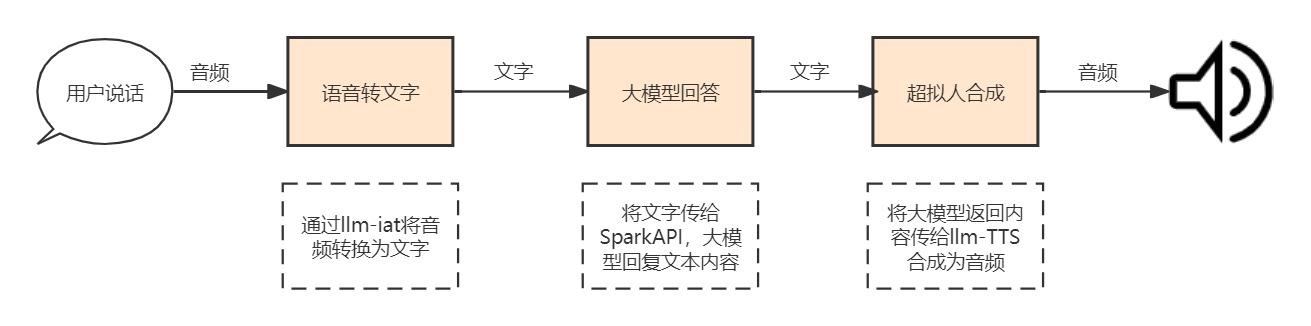
📁 语音大模型实现流程/
- 📄 llm_iat.py 7.8KB 下载
- 📄 readme.txt 582B 下载
- 📄 sparkAPI.py 5.0KB 下载
- 📄 super_smart_tts.py 7.3KB 下载
- ⚙️ 语音大模型实现流程.jpg 56.2KB 下载
课程大纲图
- 🖼️ 星火语音识别与合成大纲.png 147.6KB